
6 Ways a BMI Calculator for Men Helps Assess Eligibility for a Health Insurance Policy
New Delhi [India], March 25: Applying for health insurance policy and wondering why insurers keep asking about your height and weight? They’re calculating your BMI. And that number matters way more than most people think.
Here’s how BMI calculator for men actually affects your insurance eligibility and premiums.
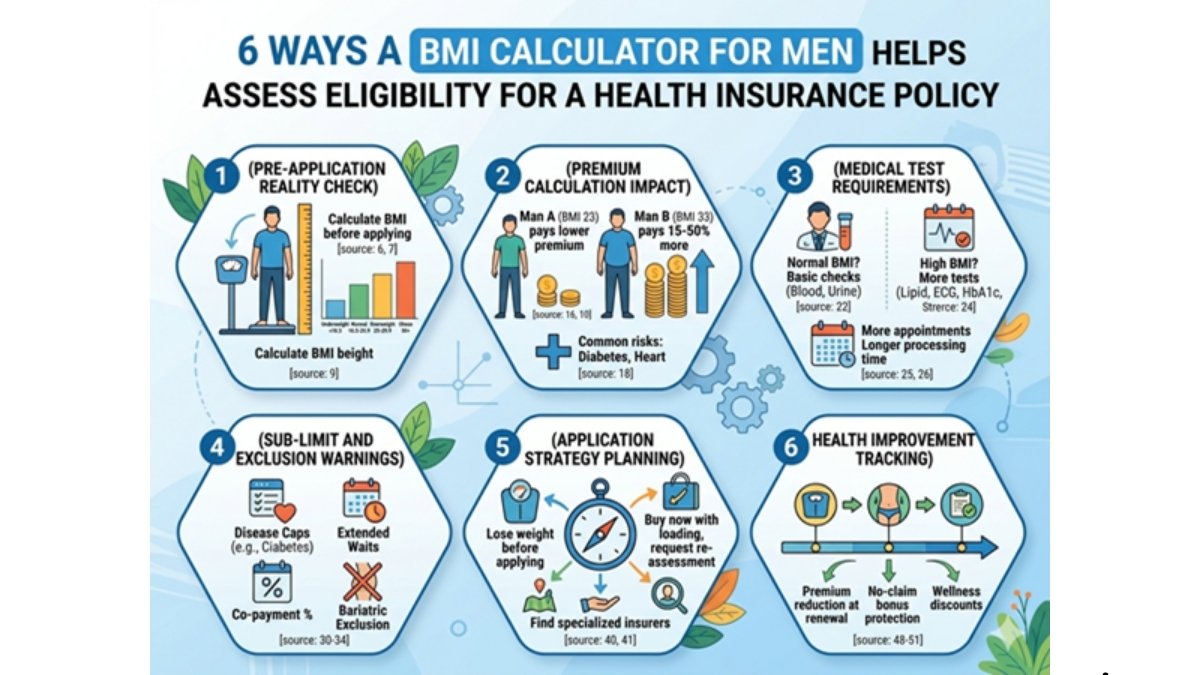
Way 1: Pre-Application Reality Check
Before applying for health insurance policy, BMI calculator for men shows where you stand.
Calculate: Weight (kg) divided by height (meters) squared.
75 kg man, 1.75m tall = BMI 24.5 (normal) 95 kg, same height = BMI 31 (obese)
Insurance ranges: Below 18.5: Underweight 18.5-24.9: Normal 25-29.9: Overweight 30-34.9: Obese Class I 35+: Obese Class II & III
Normal BMI? Standard premiums. BMI above 30? Expect 15-50% premium increase. BMI above 35? Some insurers reject outright. Others accept with 50-100% loading.
Knowing BMI before applying sets realistic expectations.
Way 2: Premium Calculation Impact
BMI calculator for men directly influences what you actually pay for coverage.
Two 35-year olds, same ₹10 lakh coverage:
Man A: BMI 23, pays ₹12,000 yearly Man B: BMI 33, pays ₹17,000-18,000 yearly
₹5,000-6,000 extra annually. Over 20 years, that’s ₹1-1.2 lakhs additional.
Why? Higher BMI means higher risk of diabetes, hypertension, heart disease, joint problems, sleep apnea, certain cancers.
Higher risk equals higher premium. Simple math.
Some men at BMI 29.5 lose 3-4 kg before medical tests. Getting under 25 saves thousands over policy lifetime.
Way 3: Medical Test Requirements
Normal BMI? Basic health check – blood work, urine, blood pressure.
High BMI triggers more:
BMI 30-35: Lipid profile, fasting glucose, liver function, ECG. BMI above 35: Add HbA1c, cardiac workup, sometimes stress test or ultrasound.
More tests mean more waiting, more appointments, more chances something complicates application.
BMI calculator for men helps anticipate this. BMI 34? Plan for 2-3 medical visits, 2-3 weeks processing instead of standard 7-10 days.
Budget for test costs too. Some insurers reimburse only if approved. Rejection means ₹3,000-5,000 out of pocket.
Way 4: Sub-Limit and Exclusion Warnings
High BMI brings health insurance policy restrictions even when approved.
Common restrictions for BMI 32+:
Disease caps: Diabetes complications capped at ₹2 lakhs even with ₹10 lakh total coverage. Cardiac issues capped at ₹5 lakhs.
Extended waits: Standard 2-year wait becomes 3-4 years for obesity-related conditions.
Co-payment: You pay 20-30% of every weight-linked claim.
Bariatric exclusion: Weight-loss surgery is excluded completely.
The BMI calculator for men reveals if you’re in restriction zone. BMI 28? Safe. BMI 34? Read policy carefully for these clauses.
Better knowing upfront than discovering when filing claim years later.
Way 5: Application Strategy Planning
BMI calculator for men shapes application strategy.
BMI 27: Borderline. Lose 4-5 kg before applying. Drop to 25, get standard rates.
BMI 32: Clearly over. Buy now with loading then request re-assessment after weight loss, or delay 3-4 months to lose weight first. Depends on urgency.
BMI 38: Very high. Find specialized insurers, use employer group insurance, buy whatever available, work on weight reduction.
BMI calculator for men isn’t just diagnostic. It’s strategic planning tool.
Way 6: Health Improvement Tracking
Once you have health insurance policy, BMI calculator for men tracks improvement for future benefits.
Many insurers offer:
Premium reduction on renewal: BMI dropped from 32 to 26? Request re-assessment. Documented weight loss can cut loading by 25-50% at renewal.
No-claim bonus protection: Healthy BMI helps avoid claims, protecting bonus accumulation.
Wellness discounts: Some insurers discount premiums for wellness program participation. BMI reduction is a measurable goal.
Portability advantages: Switching insurers is easier with improved BMI. New insurer treats BMI 24 more favorably than the old policy’s BMI 34.
Track BMI quarterly. Document trends. Maintained 10+ point reduction for 6-12 months? That’s leverage for better terms.
Understanding Limitations
The BMI calculator for men isn’t perfect.
Muscular men with low body fat show high BMI. Bodybuilder at 90kg, 1.75m has BMI 29 – “overweight” – despite being fit.
Insurers know this. Underwriters check waist circumference, body fat percentage, actual health markers (blood pressure, glucose, lipids), and fitness level.
High BMI from muscle mass? Excellent medical tests usually override BMI concerns.
But BMI is still the starting point. High number triggers scrutiny. You’ll need to prove it’s muscle, not fat.
Practical Steps
Use the BMI calculator for men effectively:
Calculate current BMI honestly.
If above 27, check the three insurers’ underwriting guidelines.
If 30+, calculate a realistic weight loss timeline. 8-10 kg takes 3-4 months safely.
Decide – buy now with loading or delay for better rates?
If buying with high BMI, read sub-limits carefully.
Post-purchase, track monthly. Document reductions for premium negotiations.
Common Mistakes
Lying about height to lower BMI. Medical exam measures you. Lying gets the application rejected.
Crash dieting the week before tests. Extreme weight loss triggers other markers. Plus unsustainable.
Ignoring BMI as “just a number.” For underwriters, it’s the primary risk indicator.
Thinking BMI is the only factor. Combined with blood pressure, diabetes markers, cholesterol, and smoking.
Accepting the first quote without shopping. Some insurers are more lenient on BMI than others.
Bottom Line
The BMI calculator for men is a simple tool with significant health insurance policy implications.
Calculate your BMI before applying. Understand where you fall on the underwriter’s risk scale. Plan application timing accordingly.
High BMI doesn’t mean you can’t get coverage. Means you need realistic expectations about premiums, restrictions, and possible rejections.
Use BMI as a motivation tool, not just an insurance metric. Losing weight helps both your health and your wallet through lower premiums and better coverage terms.
Insurance companies will calculate your BMI during a medical exam anyway. Better to know the number first and plan your application strategy accordingly.
Check your BMI today. Know where you stand. Make informed decisions about when and where to apply for coverage.
Simple calculation. Significant implications for your insurance costs and eligibility.
If you object to the content of this press release, please notify us at [email protected]. We will respond and rectify the situation within 24 hours.