
AI Investments are Rising, But Why Are Enterprises Still Failing to Scale Impact?
New Delhi [India], April 02: Global enterprise investment in artificial intelligence has crossed $200 billion, yet a growing number of organizations are confronting what industry analysts are calling a value realisation crisis. Even though adoption has been quite aggressive, only 6% of enterprises report a meaningful bottom-line impact from AI initiatives. 94% continue to remain stuck in pilot stages without effective scaling.
Why are investments not resulting in expected outcomes? This is happening more due to structural fragilities. Nearly 71% of organizations now acknowledge that their technology ecosystems are overly interdependent and increasingly brittle, making large-scale execution difficult. The result is a pattern where capability is expanding, but consistency remains elusive.
At the same time, the enterprise shift toward agent-driven systems is accelerating. Close to 40% of enterprise applications now incorporate task-specific AI agents, a sharp rise from just 5% in 2025. Full-scale autonomous orchestration has been achieved by only 2% of organizations. This divergence between adoption and execution is becoming one of the defining challenges of enterprise transformation.
Organizations leading this transition are not only scaling technology, but also navigating a noticeable rise in operational complexity. Many of these enterprises now manage upwards of 1,057 applications. This has enhanced their system complexities by nearly 50%. All evidence indicates that this expansion is not limited to infrastructure alone. It is exposing deeper structural questions around how the systems had been designed, governed and sustained till date.
This backdrop has become the basis of our understanding of the process of innovation itself. The emphasis is gradually moving away from speed and experimentation. System design, governance and clear execution pathways are more important. Instead of just speed, focus is more on function reliably at scale.
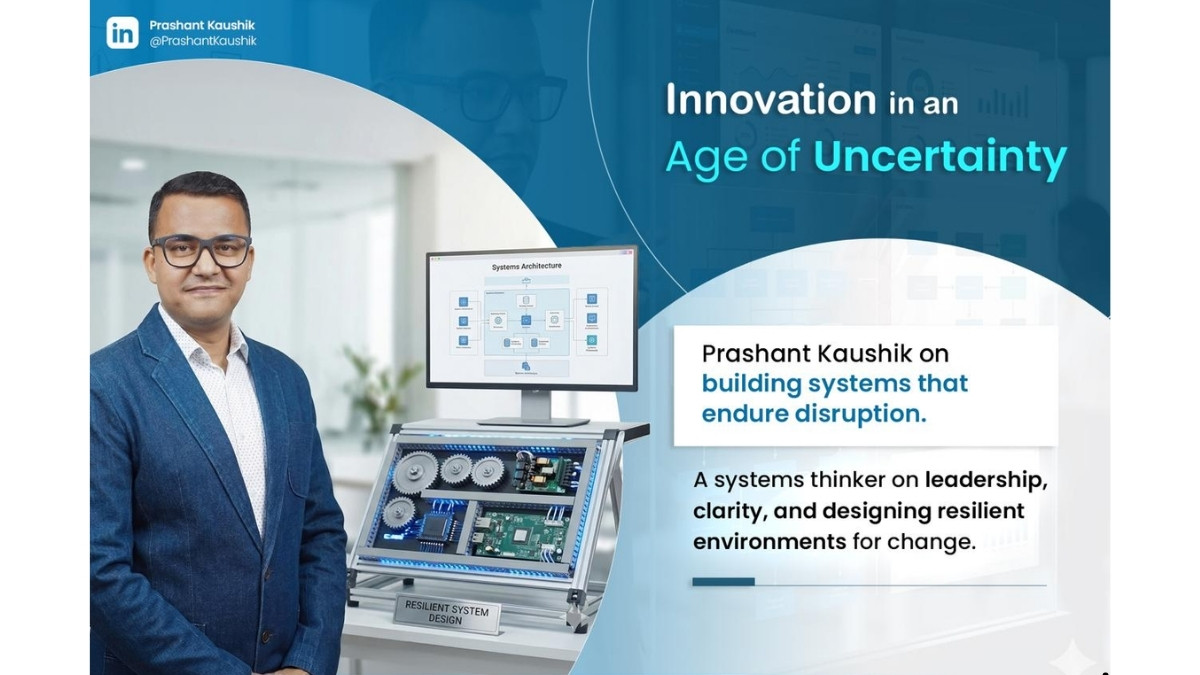
Prashant Kaushik, a senior engineering and systems leader based in Bengaluru, articulates this transition through a perspective that is increasingly resonating across enterprise leadership conversations.
“Innovation is often mistaken for intensity,” Kaushik notes. “We celebrate breakthroughs and rapid problem-solving, but rarely question whether those solutions are designed to survive scale. If something works only under pressure but fails under growth, it was not a true innovation, could be a great effort.”
His observation reflects what many organizations are beginning to experience firsthand. The difficulty in scaling is rarely due to a lack of technology. More often, it stems from the absence of architectural clarity in systems that are expected to operate within growing layers of complexity.
“Technology is evolving faster than operating models,” Kaushik explains. “Organizations are introducing advanced systems into environments that were not designed to support them. The result is not transformation but enhanced friction.”
This friction is not a visible breakdown of systems. Its appearance is subtle in nature. Things like slower decisions, unclear ownership and outcomes are observed even with similar inputs. The systems are definitely more advanced but lack clearly defined structures. This doesn’t let organizations achieve consistent performance. In many cases, this is where the execution gap begins to widen.
Multi-agent ecosystems are on the rise. Intelligent systems are now beginning to collaborate and make decisions with minimal intervention. Therefore, the need for structured governance becomes more pronounced.
“Leadership today is less about control and more about clarity,” Kaushik states. “When systems become autonomous, ambiguity becomes the biggest risk. If decision ownership is unclear, even the most advanced systems can amplify confusion.”
This shift is also intersecting with regulatory developments. India is now continuing shaping frameworks around digital governance and emerging technologies. This makes auditability and traceability within enterprise systems become even more important.
“In a regulated landscape, an autonomous system without an architectural guardrail is not an asset,” Kaushik adds. “It becomes a liability waiting to happen.”
The implications impact the overall organizational structure. Centralized decision-making gradually makes way for models where execution is closer to the point of action. The result is faster responses. Simultaneously, it also places greater importance on clearly defined boundaries and accountability.
Alongside these structural changes, a cultural shift is also becoming visible.
“In many organizations, success has historically been tied to individuals who can solve problems quickly under pressure,” Kaushik says. “But at scale, that becomes a limitation. If a system depends on individual brilliance, it cannot sustain growth.”
This distinction between effort-driven execution and system-driven innovation is becoming easier to observe. Reactive problem-solving is not going to help. Organizations pursuing this approach will consistently encounter fatigue, inefficiencies and recurring disruptions. In contrast, those investing in architectural thinking are beginning to demonstrate more stable and predictable outcomes over time.
“Real innovation is not about solving more problems,” Kaushik emphasizes. “It is about designing systems where fewer problems occur in the first place.”
His approach has also found recognition at global platforms, including a United Nations-associated forum, where his contributions to system-driven leadership and scalable enterprise design were acknowledged. Such discussions are all highlighting a common challenge across industries. It is about balancing technological advancement with sustainable operational structures.
“There is no universal playbook for transformation,” Kaushik observes. “Every system is evolving in real time. What differentiates successful organizations is not certainty, but clarity of intent and discipline in execution.”
As enterprises continue to operate within increasing layers of complexity, the lens through which innovation is evaluated is also evolving. It is no longer being judged solely by outcomes, but by the resilience, predictability, and governance of the systems that support those outcomes.
“The future may not reward the fastest organizations,” Kaushik concludes. “It will reward the clearest ones. Clarity in decision-making, clarity in ownership, and clarity in design will determine whether innovation scales or stalls.”
For more insights on systems thinking, leadership, and enterprise-scale innovation, Prashant Kaushik shares his perspectives on his LinkedIn profile.
If you object to the content of this press release, please notify us at [email protected]. We will respond and rectify the situation within 24 hours.