India’s Infrastructure Race: Can Execution Keep Up with Ambition — The Translite Scaffolding Perspective
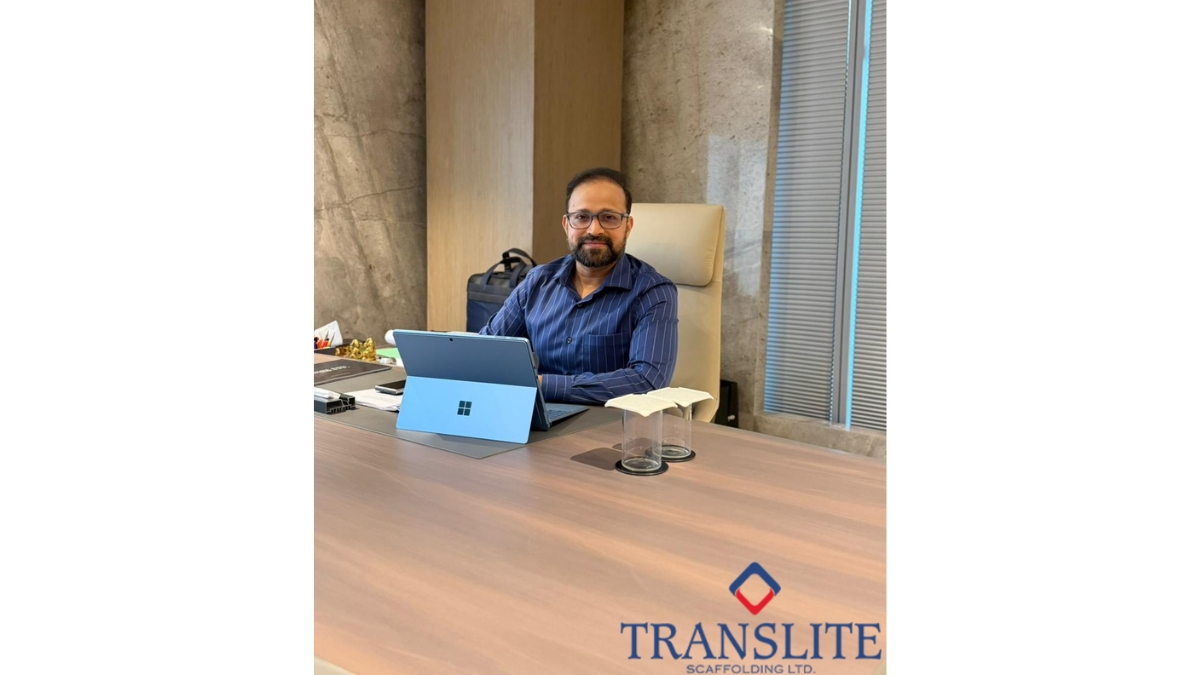
Mayank Pathak, Founder & Managing Director, Translite Formwork & Scaffolding
New Delhi [India], May 5: India is building. The numbers alone tell a story of extraordinary national ambition — over ₹11 lakh crore allocated to infrastructure in Union Budget 2024-25, 50,000 kilometres of highways under development, metro rail networks expanding across 27 cities, and the country’s first high-speed rail corridor taking shape between Mumbai and Ahmedabad. Add to that the smart cities mission, industrial corridors, logistics parks, and greenfield airports, and the scale becomes difficult to comprehend.
But ambition and execution are two different things.
While India’s infrastructure pipeline is genuinely world-class in its vision, the construction ecosystem that must convert blueprints into reality faces a persistent and largely overlooked gap — the quality, engineering, and reliability of temporary structural systems that make permanent infrastructure possible. Scaffolding, formwork, and construction access systems are not the glamorous end of the story. But they are, increasingly, the deciding factor between projects that deliver on time and those that don’t.
The Execution Layer Nobody Talks About
Every metro viaduct, every elevated expressway, every bridge pier, and every industrial facility begins with a temporary structure — a scaffold or formwork system that bears the load of construction until the permanent structure can stand on its own. These systems determine how fast work progresses, how safe the site is, and how precisely the final structure is built.
Yet, in most infrastructure planning conversations, construction scaffolding systems and modular formwork solutions are treated as commodities — procured last, budgeted low, and evaluated mainly on price.
This is where India’s execution gap begins.
Translite Scaffolding: Engineering the Base Layer
Noida-based Translite Scaffolding Ltd., founded in 2011 by Mayank Pathak, has spent over a decade challenging this mindset. With a 14,000 square meter manufacturing facility, a production capacity of 2,000 MT per month, and a project portfolio that spans the Mumbai-Ahmedabad High Speed Rail corridor, Delhi Metro, Dwarka Expressway, Ganga Expressway, the New Parliament Building, Adani’s Dhamra LNG Plant, and industrial campuses for Hyundai, Oppo, and TCS — Translite has quietly become one of the most significant scaffolding and formwork manufacturers in North India.
The company’s clients include Tata Projects, L&T, Afcons, NCC, HG Infra, and Shapoorji Pallonji — names that define India’s EPC (Engineering, Procurement, and Construction) sector.
What distinguishes Translite is not just scale. It is the insistence on treating scaffolding as an engineering discipline rather than a supply transaction.
From Cuplock to Ringlock: The Safety Shift India Needs
One of the clearest indicators of India’s evolving construction standards is the ongoing transition from Cuplock scaffolding systems to Ringlock scaffolding systems across complex infrastructure projects.
Cuplock has long been the dominant system in India — inexpensive, familiar, and widely available. But on projects demanding precise geometry, high load-bearing capacity, and fast assembly, its limitations are increasingly visible. Ringlock scaffolding, with its standardized rosette connectors, tool-less assembly, and predictable load behaviour, is now the preferred system for metro rail construction, bridge formwork, elevated highway projects, and high-speed rail infrastructure.
Translite manufactures both systems, alongside H-Frame and Kwik Stage scaffolding — with all products certified to ISO 9001:2015, IS 1161, and IS 2062 standards. More importantly, the company integrates design engineering into its supply offering: load calculations, formwork layout planning, and erection support are built into every project engagement.
This approach — engineering-led rather than inventory-led — is what India’s infrastructure execution actually demands.
The Custom Formwork Advantage
Generic scaffolding fails at the intersection of complexity and speed. The Mumbai-Ahmedabad Bullet Train corridor, the Kalamboli rail flyover, and DMRC metro extensions are not projects where one-size-fits-all solutions work. Each structure has unique geometry, load distribution requirements, and site constraints.
Translite’s custom formwork solutions — including pier shuttering, girder shutters, slab formwork, and heavy steel fabrications — are engineered specifically for project conditions, using CAD modelling and structural simulation before fabrication begins. The result: faster installation, fewer on-site adjustments, reduced rework, and improved structural accuracy.
Going Global: India’s Scaffolding Exports to the Middle East
India’s ambition in infrastructure is not limited to its own borders. Translite’s expansion into the Middle East scaffolding market — with active supply to UAE, Saudi Arabia, and GCC countries — reflects a broader opportunity for Indian engineering manufacturers to compete on the global stage.
As Gulf nations push forward with Vision 2030 projects, major real estate developments, and industrial infrastructure, demand for quality scaffolding and formwork systems from cost-competitive, quality-reliable manufacturers is growing. Translite’s track record on some of India’s most technically demanding projects positions it as a credible partner for international construction contractors.
The Verdict: Execution Needs a System Upgrade
India’s infrastructure race will not be won by allocation alone. Every budget announcement, every project sanction, every policy push must eventually translate to on-ground execution — and that execution depends on the quality of the systems, materials, and engineering that support construction at the site level.
Modular scaffolding systems, precision formwork engineering, construction site safety standards, and reusable temporary structures are not footnotes in the infrastructure story. They are the story — or at least, the part that determines whether the story ends on time.
Companies like Translite Scaffolding are making the case, one project at a time, that India’s execution layer can match its infrastructure ambition. The question is whether the broader industry — developers, EPC contractors, policy planners — is paying attention.
Translite Scaffolding Ltd. is headquartered in Noida, Uttar Pradesh. The company specialises in scaffolding and formwork manufacturing, rental, and engineering services for infrastructure, industrial, and commercial projects across India and the Middle East. www.translitescaffolding.com
If you object to the content of this press release, please notify us at [email protected]. We will respond and rectify the situation within 24 hours.