From Patents to Partnerships: How Pon Maa Kishan Is Opening India’s Research Ecosystem to the World
Chennai (Tamil Nadu) [India], August 7: As global companies increasingly look to India not just as a manufacturing base but as a genuine R&D destination, one figure has spent over a decade quietly building the bridges that make that transition possible: Pon Maa Kishan, Founder & CEO of SUKISHTM and Technology Transfer Officer (TTO) at VIT Chennai’s Office of Intellectual Property Strategy (IPS).
For international organizations weighing where to locate their next research center, joint lab, or innovation partnership, the biggest obstacle is rarely talent or infrastructure — it’s translation. Translating a university’s IP portfolio into commercial language. Translating a foreign company’s technical roadmap into terms an Indian research institution can act on. Translating goodwill into a signed, enforceable agreement. This is the work Kishan has built his career around.
A Single Point of Contact for a Complex Ecosystem
As the sole Technology Transfer Officer for VIT Chennai’s entire campus, Kishan manages a portfolio of over 1,400 filed and published patents and more than 200 granted patents — one of the largest active technology transfer pipelines at any Indian private university. For an international R&D team, that scale matters: it means access to a deep, pre-vetted bench of Indian-origin innovation across electromagnetics, non-destructive testing, aerospace, energy, and emerging technology domains, routed through one accountable relationship rather than a maze of departments.
Over the past year alone, Kishan has led patent mapping and collaboration exercises with a cross-section of industry that illustrates how broad this bridge has become — including automotive innovators and a bio-tech knowledge partnership. He has also structured technology transfer agreements and NDAs with clean-energy and deep-tech firms such as Holm Energy, H2One Cleantech, and BlackMass Energies, and drafted an MoU with TP Solar Limited for joint technology co-development.
Built for the Realities of Cross-Border Collaboration

What distinguishes Kishan’s approach is precision on the legal and structural details that international partners care about most. He has personally drafted and negotiated:
- Clean, irrevocable IP transfer agreements designed to give commercial partners unambiguous ownership
- IP clauses in international MoUs — structured to protect the Indian institution’s position while remaining workable for the foreign partner
- Patent licensing and transfer negotiations with companies across IoT, defense, and industrial technology
This is not generic “innovation facilitation.” It is contract-literate, patent-literate deal-making — the exact skill set that turns a promising conversation between a foreign R&D head and an Indian university into a bankable agreement.
A Track Record of Building Institutions, Not Just Deals
Kishan’s credibility comes from having built ecosystem infrastructure before, not just brokered within it. He co-established the ACEII Foundation at AMET University — India’s first maritime-focused incubation centre — and BRIIC at Hindustan University, mentoring more than 50 startups across both. Through his earlier venture, TEMS Tech Solutions, he engaged with national research and defense institutions including ISRO, DRDO, HAL, and NASA. His contributions to India’s innovation economy have been recognized with a NITI Aayog Mentor of Change designation and a breaker of Guinness World Record.
Why This Matters for International R&D Strategy
For a foreign company evaluating India, the calculus usually comes down to three questions: Is there real research depth here? Can we actually get to it? And can we structure a deal that protects our IP while respecting India’s institutions? Kishan’s work answers all three at once. His 14-week industry engagement log from April–July 2026 alone documented over 290 industry touchpoints, translating into signed agreements and active negotiations — a pace and rigor more typical of a dedicated corporate business development function than a university office.
“India’s research ecosystem isn’t short on innovation — it’s short on people who can walk into a lab and a boardroom on the same day and speak both languages fluently,” Kishan says. “That’s the gap I’ve built my career closing.”
Mr. Kishan with Hon’ble Higher Education Minister of Tamil Nadu Thiru P. Viswanathan
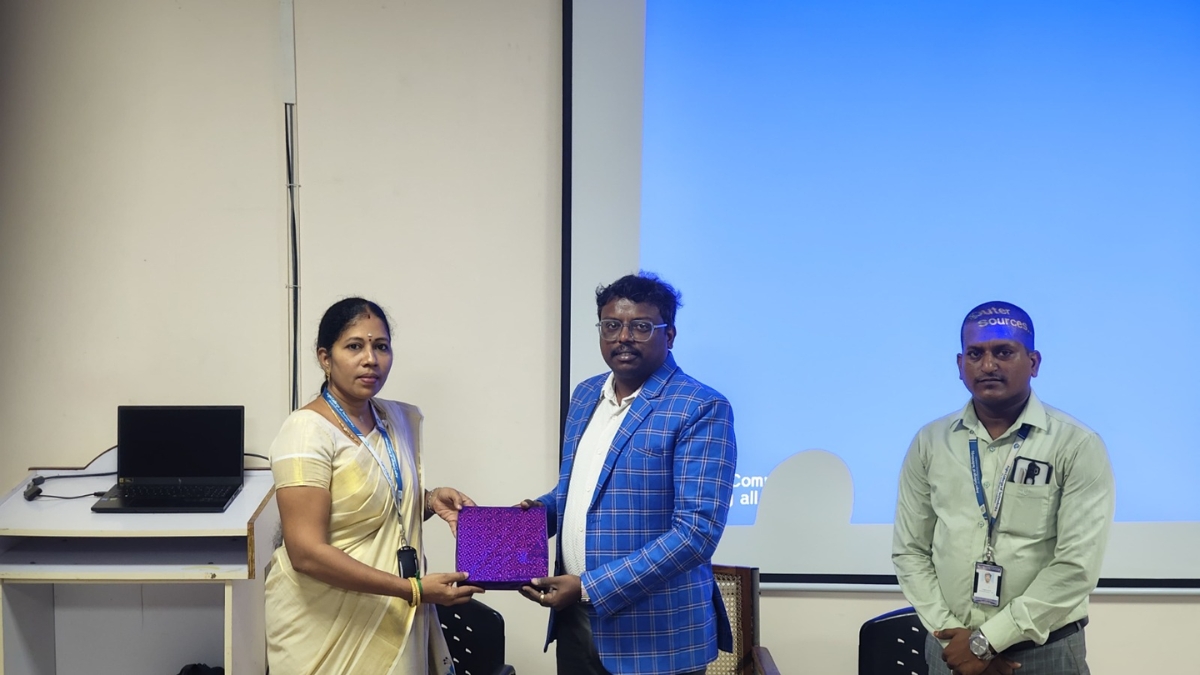
Mr. Kishan was invited to deliver a guest lecture at Agni College of Technology and also explored discussion about drone manufacturing at Garuda Aerospace Chennai.
If you object to the content of this press release, please notify us at [email protected]. We will respond and rectify the situation within 24 hours.